
The Engineer Within: Lessons From Beneath the Surface
I did not become curious because I became an engineer. If anything, I became an engineer because I was curious. Long before I studied thermodynamics, fluid mechanics, or risk analysis, I was a child growing up in Puerto Rico, spending countless hours outdoors. The ocean was always nearby. The shoreline became one of my first classrooms. I remember ... (continue reading)
OCEANS
I did not become curious because I became an engineer. If anything, I became an engineer because I was curious.
Long before I studied thermodynamics, fluid mechanics, or risk analysis, I was a child growing up in Puerto Rico, spending countless hours outdoors. The ocean was always nearby. The shoreline became one of my first classrooms. I remember watching waves reshape the beach after storms, observing how currents carried seaweed and debris, and wondering why the ocean looked different from one day to the next. I had no idea that these observations had anything to do with engineering. I was simply fascinated by how the world worked.
That curiosity followed me throughout my life. As a competitive swimmer, I became interested in efficiency and movement through water. As a lifeguard and swim instructor, I learned to pay attention to people, conditions, and subtle signs of trouble before they became emergencies. Later, as an engineer, I learned formal methods for analyzing systems, understanding uncertainty, and evaluating risk. Eventually, diving brought all of these experiences together in a way I never expected.
For many years, I thought engineering was primarily a profession. It was something people studied in universities and practiced in offices, laboratories, and industrial facilities. Yet the more I reflected on my experiences underwater, the more I began to question that assumption. I started to realize that the qualities I admired most in exceptional divers were not technical skills alone. They were habits of mind. The best divers were observant. They noticed small changes in conditions. They asked questions. They remained humble. They adapted when circumstances changed. They learned from mistakes. In many ways, they were doing exactly what engineers do.
Perhaps the difference is that engineers receive formal training to cultivate these habits, while others develop them through experience. The underlying way of thinking, however, belongs to all of us.
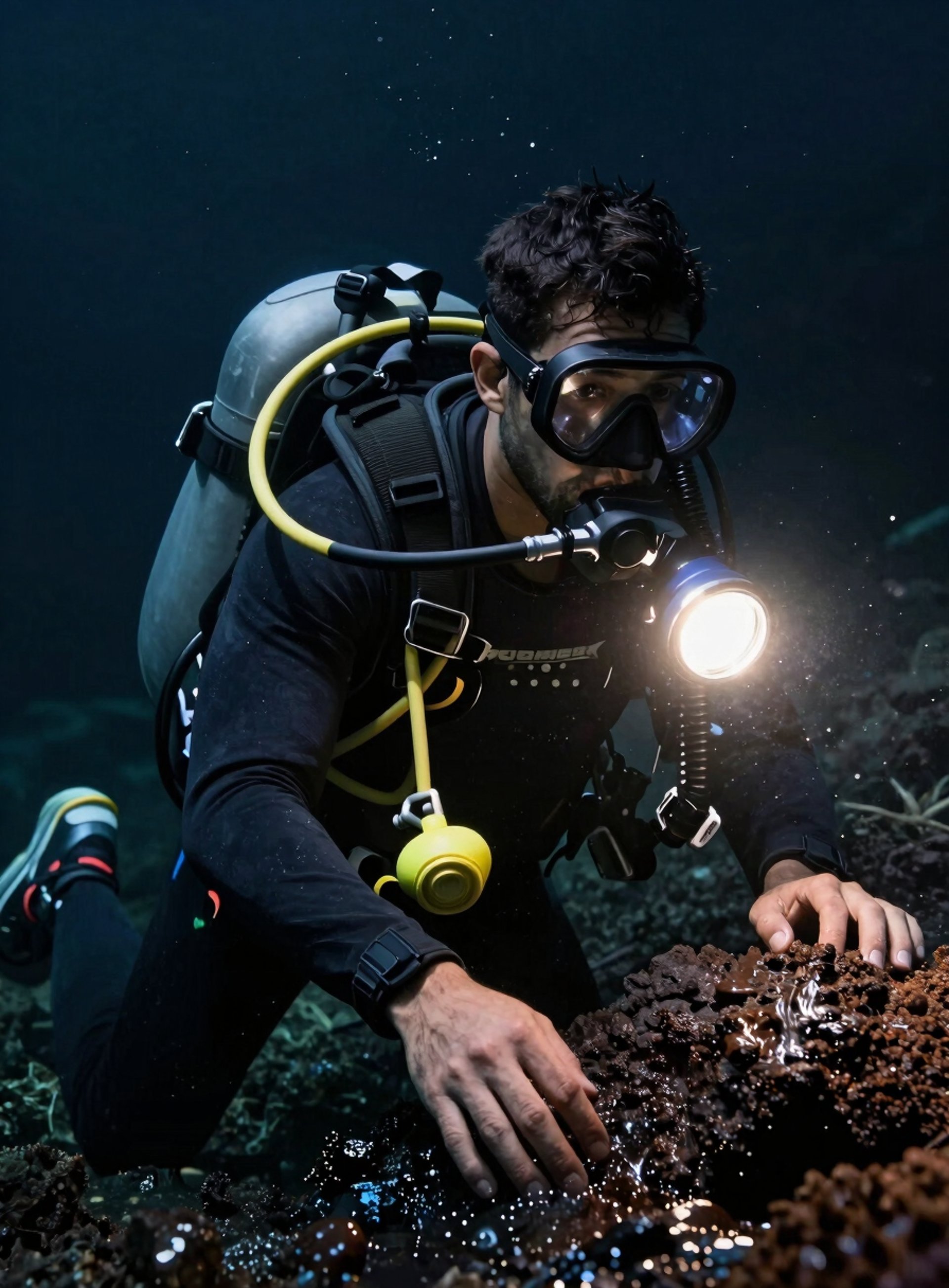
This realization became clearer during a dive in Puerto Rico. The conditions were not particularly difficult. Visibility was lower than expected but still manageable. Our group consisted of experienced divers, including an instructor, a divemaster, and certified divers. Everyone carried a camera. At the time, that seemed like a minor detail. After all, underwater photography is one of the great joys of diving. It allows us to capture moments that few people ever experience and to share the beauty of the underwater world with others.
As the dive progressed, visibility gradually deteriorated. Fine sand suspended in the water reduced contrast and shortened our field of view. Divers became more focused on photographing marine life and less aware of the spacing between members of the group. No one made a major mistake. No equipment failed. No emergency occurred. Yet little by little, the conditions changed. Distances increased. Awareness narrowed. Eventually, part of the group became separated from the rest.
Everyone surfaced safely, and in many ways it could have been dismissed as an uneventful dive. But afterward I found myself thinking about what had happened. Not because something went wrong, but because I wanted to understand what had happened and why.
The questions began to multiply. How much did reduced visibility contribute to the separation? Did carrying cameras increase task loading and reduce situational awareness? Were we operating under different assumptions about acceptable group spacing? Had we discussed clear separation procedures beforehand? What would have happened if visibility had been slightly worse? What if the current had been stronger? What if one diver had experienced an equipment problem at the same time?
These were not questions about assigning blame. They were questions born from curiosity. They were attempts to understand a system.
That, I realized, is fundamentally what engineering is.
Engineering is often associated with equations, technology, and infrastructure. Those things are certainly part of it. But beneath the calculations lies something much simpler. Engineering begins with observation. It begins by asking questions. Why did this happen? What factors contributed to the outcome? What assumptions are we making? What are we overlooking? How might conditions change in the future?
These are not exclusively engineering questions. They are human questions.
When a child takes apart a toy to see how it works, there is an engineer present. When a fisherman learns to read weather patterns, there is an engineer present. When a hiker studies a map before entering unfamiliar terrain, there is an engineer present. When a diver adjusts a plan based on changing conditions underwater, there is an engineer present.
The ocean has a remarkable way of revealing this side of ourselves.
Every dive is an encounter with uncertainty. Conditions rarely unfold exactly as expected. Visibility changes. Currents shift. Marine life appears where we least expect it. Equipment behaves differently than it did during the previous dive. We enter the water with a plan, but we must constantly compare that plan to reality. In many ways, every dive becomes a small experiment.
We gather information before entering the water. We make predictions about what conditions might be like. Once underwater, we test those predictions against actual observations. We adapt our decisions based on what we learn. Then, after the dive, we reflect on the outcome and incorporate those lessons into future dives.
Educational researchers describe this process as experiential learning, a cycle of observation, action, reflection, and adaptation (Kolb, 1984). Scientists recognize it as part of the scientific method. Engineers view it as continuous improvement. Divers simply call it experience.
The labels may differ, but the process remains remarkably similar.
One lesson the ocean repeatedly teaches is humility. Nature does not care about our certifications, our experience level, or our confidence. The laws of physics operate the same way for everyone. Water pressure increases predictably with depth. Gas behaves according to well-established principles. Human attention remains limited regardless of how skilled we believe ourselves to be.
This humility is one of the reasons I find diving so rewarding. The underwater environment constantly reminds us that learning never ends. There is always more to understand. There is always another variable to consider. There is always another perspective we may have overlooked.
In engineering, accidents are rarely attributed to a single cause. Researchers studying human factors and organizational safety have found that incidents often emerge from the interaction of multiple small conditions and decisions rather than one catastrophic error (Reason, 1990). Diving is no different. A change in visibility may not be significant on its own. Neither is carrying a camera. Nor is slight group separation. Yet when several small factors interact simultaneously, the outcome can become very different.
Recognizing these interactions requires curiosity and awareness. It requires us to think beyond individual events and consider systems.
The longer I dive, the more I believe that systems thinking may be one of the most valuable skills divers can develop. Not because it makes us engineers, but because it helps us become more thoughtful observers of our environment. We begin to see connections between conditions, decisions, behaviors, and outcomes. We become less focused on finding simple explanations and more interested in understanding complexity.
This perspective extends beyond diving. It influences how we approach hiking, photography, travel, conservation, and even daily life. It encourages us to ask better questions. It reminds us that uncertainty is not necessarily a problem to eliminate but a reality to understand.
Perhaps that is why the shoreline continues to inspire me. The shore is a place of transition. It is where land meets sea, where certainty meets uncertainty, where the familiar meets the unknown. Standing at the edge of the ocean, we are reminded of both our limitations and our capacity to learn.
The same is true underwater.
Every dive offers an opportunity to observe, question, reflect, and grow. Every dive teaches us something about the ocean and something about ourselves. The lessons are not reserved for scientists, engineers, or professional divers. They are available to anyone willing to pay attention.
Looking back, I no longer see engineering as merely a profession or a collection of technical skills. I see it as an expression of something deeply human. The desire to understand. The willingness to ask questions. The humility to recognize what we do not know. The discipline to learn from experience.
Those qualities existed long before I earned an engineering degree.
They existed when I was a swimmer, when I worked as a lifeguard, when I first learned to dive, and when I stood on the beaches of Puerto Rico wondering why the ocean never looked exactly the same twice.
I suspect they exist within all of us.
The ocean simply helps us remember.
REFERENCES:
Kolb, D. A. (1984). Experiential learning: Experience as the source of learning and development. Prentice-Hall.
Reason, J. (1990). Human error. Cambridge University Press.
Reason, J. (1997). Managing the risks of organizational accidents. Ashgate.
Endsley, M. R. (1995). Toward a theory of situation awareness in dynamic systems. Human Factors, 37(1), 32–64.
Kahneman, D. (2011). Thinking, fast and slow. Farrar, Straus and Giroux.