

Following the Water
The memories, questions, and discoveries that connect us to water. There are things about water that have stayed with me since childhood. The smell of rain before it arrives, the sound of rainfall approaching through the mountains, growing louder as it moves across the landscape, and the continuous sound of a river, sometimes gentle, sometimes powerful enough to drown out everything around it. These are memories that have remained with me long before I understood the science behind them. I remember . . . (Continue Reading)
DEORILLA


From childhood memories in Puerto Rico to engineering and scuba diving, a lifelong curiosity about where water goes.
Most days, Quebrada Mariana was a quiet stream behind my childhood home in Humacao, Puerto Rico. Then a storm would come. The water rose, the current grew stronger, and the stream became a raging river. Even now, I can hear its roar.
Near our house in Villa Universitaria, a stormwater drain emptied into the stream. When the rain was heavy, water rushed out of the drain and met the current, creating whirlpools and swirling eddies. I would watch, fascinated and a little frightened, as the water churned below. After some storms, the banks were so badly eroded that parts of the stream were almost unrecognizable. Places I knew had changed or disappeared. I didn't understand what caused all that turbulence or why the banks changed so much. I just knew that the stream behind our house could become powerful enough to reshape its surroundings.
I loved the rain, too. I still remember its smell before a storm and the sound of an aguacero moving across the mountains and growing louder as it came closer. When the roadside drainage channels filled with water, I made little paper boats and sent them downstream. I'd follow them along the street, trying to keep them from getting stuck or disappearing into a storm drain. Sometimes I could rescue them. Sometimes they were gone. It was a simple game, but I was curious about where the water went after it disappeared beneath the street. Did it reach a river? Did it eventually make its way to the ocean? I didn't know. I just wanted to see how far my boat would travel.
Growing up on an island, I was never far from water. There were rivers coming down from the mountains, streams that changed with the rain, mangroves along the coast, and the Atlantic stretching beyond the horizon. I didn't think of these places as connected; I experienced each one differently. One place that always impressed me was the mouth of the Río Grande de Loíza. I remember looking at the river as it reached the Atlantic and wondering what happened to all that freshwater. Where did the river end and the ocean begin? Freshwater mixes with saltwater, while sediments carried downstream may settle near the coast or continue moving with the currents. Standing there, though, I wasn't thinking about any of that. I was watching a river disappear into something much bigger than itself.
In high school, an Earth Science assignment sent me to collect leaves from different species of mangroves. It was unlike the beaches and rivers I knew. There was muddy water, vegetation, and life everywhere. And the smell. Oh, that smell! It was strong and unpleasant, rising from the wet ground and decaying leaves, nothing like the smell of rain or the familiar scent of the sea. I wondered how so much life could exist in a place that smelled that way. Fallen leaves were decomposing, microorganisms were at work in the mud, and all kinds of organisms depended on what was happening there. What looked like dirty, stagnant water was supporting a thriving ecosystem. A place didn't have to look clean or beautiful to be full of life.
That same class took me somewhere I hadn't imagined water could go. Miss Olivier, my Earth Science teacher at Ramón Power y Giralt School, organized an excursion to Cueva Los Ángeles. Inside the cave, water flowed through underground passages, while other chambers remained dry. I was amazed. Until then, rivers were things I saw crossing the surface of the island. Here was water moving beneath our feet. Where did it come from? How far had it traveled underground? Where would it come out? What I remember most is the surprise of finding a river in a place where I couldn't see the sky.
I felt something similar the first time I saw Lake Ontario and Lake Michigan. I had grown up looking at the ocean, so I knew what it meant to stand at the shore and see water stretching to the horizon. What I didn't expect was to find the same view at a freshwater lake. If someone hadn't told me otherwise, I could easily have believed I was standing beside the sea.
When I studied thermodynamics, fluid mechanics, and heat transfer, those childhood scenes kept coming back to me. Water moves in response to gravity and pressure. It carries energy and sediment and exchanges heat with its surroundings.
I often think about Quebrada Mariana in light of those ideas. The water rushing from the storm drain met the stream from a different direction and at a different speed, creating turbulence. During floods, the stronger current could carry sediment away and eat into the banks, reshaping the channel. The science helps explain what I saw, but it doesn't replace the memory of standing there, listening to that roar.
The underground river and the Great Lakes belong to that same story. We usually learn the water cycle as a tidy loop of arrows: ocean, clouds, rain, rivers, and back to the sea. In reality, some water reaches the sea within hours, while some seeps underground and stays there for centuries. And we change those paths. A forest absorbs and releases water differently from a paved parking lot, and roads, buildings, farms, and cities affect how rainwater moves and what ends up in it. A storm drain may protect a street from flooding, but the water still has to go somewhere. That brings me back to those paper boats. The water that carried them into the drains didn't vanish. It kept moving, perhaps toward a stream like Quebrada Mariana, carrying whatever it picked up along the way.
Scuba diving has let me see those connections from the other end. Instead of watching a river or the ocean from the shore, I'm surrounded by the water itself. I can feel the current, notice changes in temperature, and watch marine life moving around me. Some days the water is crystal clear. On others, suspended particles limit how far I can see, and I wonder where they came from. Were they stirred up from the bottom by waves? Did a recent storm wash sediment into the sea? Could something happening miles inland be affecting what I'm seeing underwater? Looking at the water isn't enough to tell, but the questions stay with me.
Diving has also drawn my attention to coral reefs and the threats they face. Sediment, excess nutrients, and pollutants carried into coastal waters can harm reefs, mangroves, and seagrass beds. Ocean warming adds another serious threat, especially when marine heatwaves cause coral bleaching. What happens on land doesn't necessarily stay on land.
I think about water differently even at home. Sometimes, when I flush a toilet, I feel uneasy about how much treated water we use simply to carry waste away. In many communities, that water has been collected, treated to drinking-water standards, and delivered through miles of infrastructure, only to be flushed away to be collected and treated all over again, or sent to a septic tank. Of course, sanitation is essential. But do we need drinking-quality water for every purpose? Could appropriately treated nonpotable water serve some of those needs? Could better plumbing and more efficient fixtures reduce how much we use? There are practical and public health considerations behind those questions. Still, it strikes me how much work goes into bringing water to our homes, and how little attention we pay to what happens after it leaves.
These memories and questions are the starting point for The Journey of Water, a project I'm developing through De Orilla. I want to revisit some of these places, explore others, take photographs, talk with people who study water, and learn more about the connections between rivers, groundwater, cities, wetlands, and the sea. I don't have a particular destination in mind. There are questions I'd like to answer, but I'm just as interested in what I might discover along the way.
I still think about those little paper boats moving down the street after an aguacero. The boats are long gone. I'm still following the water.
---
Explore the project: The Journey of Water
_________________________
(c) 2025 deorilla.com
The views expressed here are my own and are provided for educational purposes only. They do not represent the views of any employer, agency, organization, or training agency.
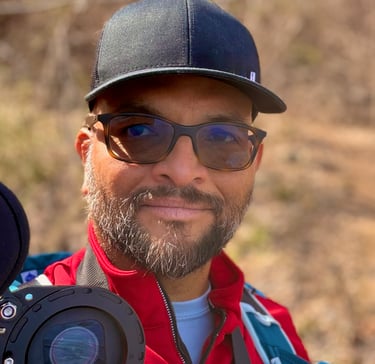
ABOUT ALEXANDER VELÁZQUEZ
ENGINEER•SCUBA DIVER • PHOTOGRAPHER
AUTHOR • MUSICIAN • EXPLORER
A personal exploration of oceans, landscapes, ideas, and the connection between them.
YOUTUBE
FLICKR