

The Heat Beneath Our Feet
When the trees disappear, what else do we lose? There is something special about the shade of a tree on a hot afternoon in Puerto Rico. You can be walking under the tropical sun, feeling the heat rise from the pavement, and suddenly step beneath a canopy of leaves. The air temperature may barely change, but the relief is immediate. The sunlight softens, the ground feels different, and for a moment the afternoon becomes a little more forgiving. We rarely think about it. We simply look for the shade. Growing up on the island, (Continue Reading)
DEORILLA


There is something special about the shade of a tree on a hot afternoon in Puerto Rico. You can be walking under the tropical sun, feeling the heat rise from the pavement, and suddenly step beneath a canopy of leaves. The air temperature may barely change, but the relief is immediate. The sunlight softens, the ground feels different, and for a moment the afternoon becomes a little more forgiving. We rarely think about it. We simply look for the shade.
Growing up on the island, I took trees for granted. They shaded homes, lined roads, covered hillsides, and offered refuge from the afternoon sun. Today, living in Maryland, I enjoy the changing seasons and the quiet forests along the trails. But the tropical landscape stays with you: the intensity of the light, the deep green, the way the heat makes you grateful for even a small patch of shade. Sometimes it takes losing something familiar to understand what it was doing for us all along.
I remember the aftermath of Hurricane Hugo in 1989. I was a teenager, and the landscape had changed almost overnight. Trees had lost their leaves, branches were scattered across the ground, and places once surrounded by green were suddenly exposed to the sun. Even the hillsides seemed bare.
What caught my attention was not only the destruction. It was the heat. Without the canopy, some places felt hotter, more exposed, less comfortable. It was clear the missing vegetation had something to do with it.
A few years later, I began studying mechanical engineering, learning about energy and thermodynamics without realizing how closely they would connect to that teenage observation. By the time Hurricane Georges stripped the island again in 1998, I had finished my bachelor’s degree, and I noticed the heat with different eyes. I suspected it had something to do with the exchange of energy between the ground, the vegetation, and the atmosphere.
I could not conclude from those experiences that the hurricanes had raised air temperatures. Humidity, wind, and weather all shape how hot we feel. But the loss of shade was unmistakable, and it left me with a question that followed me for years: when the trees disappear and its shade, what else disappears with them?
Around the same time, I noticed another transformation, one that arrived without wind, rain, or emergency warnings. Fields became subdivisions. Hillsides were cleared. Trees gave way to roads, shopping centers, and parking lots. The changes were gradual enough to seem ordinary, until an entire landscape looked different.
The two processes are not the same. A hurricane strips vegetation, and much of it recovers with time. Development can permanently replace living landscapes with pavement and concrete.
What a hurricane changes in a night, we sometimes choose to change forever.
That question followed me into graduate school at the University of Puerto Rico in Mayagüez. As I began exploring the subject, I discovered that researchers had been studying urban heat in cities around the world for generations, and that earlier scientists had already examined temperatures in San Juan. In 1986, the meteorologist Claude Duchon reported that the average annual temperature at the San Juan airport had risen about 2.1°C, nearly 4°F, between 1956 and 1983, and he traced much of that rise to the heat island and the development growing around it.
Their work inspired me. What I had noticed growing up was part of a much larger scientific question, and I wanted to understand it more deeply in San Juan, a tropical coastal city whose landscape was changing as development expanded.
The idea behind the urban heat island effect is simple, even if the science is not. Cities change how energy moves through the environment. A tree intercepts sunlight, draws water from the soil, and releases moisture into the air. Pavement and buildings absorb heat during the day and release it later. Under certain conditions, developed areas become warmer than the less-developed land around them.
In our research, we compared air temperatures in San Juan with those in surrounding rural areas and examined how the differences had changed over time. We also used an atmospheric computer model to explore different landscapes: one with natural vegetation, one representing existing urban development, and another considering possible future urban expansion. The simulations helped us understand how changing the land beneath our feet could change the movement and accumulation of heat above it.
We also projected the temperature records forward. If the trend continued, the difference between the city and the countryside around it could reach as much as 8°C, about 14°F, by 2050. It was a projection, not a destiny, and it is one result I really hope turns out to be wrong.
Our research eventually became a scientific publication in 2006. Over the years, other researchers have cited it and continued exploring similar questions. I find that meaningful, not because of the number of citations, but because it reminds me that each contribution builds on the work of others.
I learned from people who studied urban heat long before me, and perhaps our work has helped others understand their own communities. A question born from an observation in Puerto Rico became part of a conversation that extends across cities, countries, and generations.
Understanding the physics has not made the memory of standing beneath a tree any less meaningful. If anything, I appreciate the shade more.
In September 2017, Hurricane María devastated the island. When I traveled to Puerto Rico shortly afterward, the stripped trees and exposed landscapes brought back memories of Hugo and Georges. But I was no longer the teenager wondering why the landscape felt hotter. I knew that tropical heat, missing shade, and no electricity would make the days and nights difficult for families.
Before the trip, I gathered boxes of small battery-operated fans, rechargeable fans, and miniature solar panels for family and friends. Nothing extraordinary. I could not restore the grid or bring back the trees, but when the electricity is gone, a little moving air can make a humid night more bearable.
Heat is not just a number on a thermometer or a result from a simulation. It is something people live with: the person working outdoors, the older adult in a house without power, the family waiting for a breeze that never arrives. And its burden is not shared equally. Some people have air conditioning, generators, and shaded homes. Others have very few options.
That is why the way we design our communities matters. I understand we need homes, schools, businesses, and roads, and not every tree can stay. But we can preserve more mature trees, design streets with shade, leave room for vegetation, soil, and rainwater, and ask how a neighborhood will feel twenty or thirty years after it is built.
These questions belong not only to engineers but to planners, architects, developers, public officials, and the people who live there. They matter here in Maryland too, where some neighborhoods have far less shade than others.
Along the trails near my home, the leaves turn yellow and red, the branches stand bare against the winter sky, and in spring the shade returns. Landscapes are always changing, but not all changes are the same. Some are natural cycles. Others are decisions we make.
A tree may take decades to grow large enough to shade a street. It can disappear in an afternoon. And when it does, we lose more than its shadow: a place where birds rested, where rainwater met the soil, where someone stopped to escape the sun, a small piece of what made a place feel like home.
So the next time you walk beneath the hot sun, whether on a street in San Juan or a summer afternoon in Maryland, step into the shade of a tree and feel the difference.
We notice the heat when the trees disappear. Perhaps we should learn to notice the trees before they are gone.
Further reading:
Duchon, C. E. (1986). Temperature trends at San Juan, Puerto Rico. Bulletin of the American Meteorological Society, 67, 1370–1377.
Velázquez-Lozada, A., González, J. E., & Winter, A. (2006). Urban heat island effect analysis for San Juan, Puerto Rico. Atmospheric Environment, 40(9), 1731–1741. https://doi.org/10.1016/j.atmosenv.2005.09.074
U.S. Environmental Protection Agency. Heat Island Effect. https://www.epa.gov/heatislands
_________________________
(c) 2025 deorilla.com
The views expressed here are my own and are provided for educational purposes only. They do not represent the views of any employer, agency, organization, or training agency.
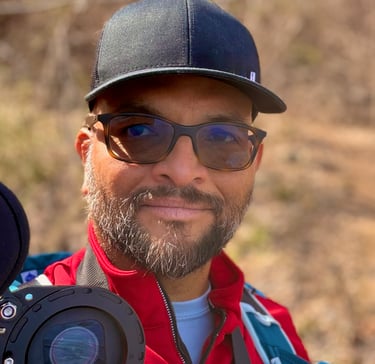
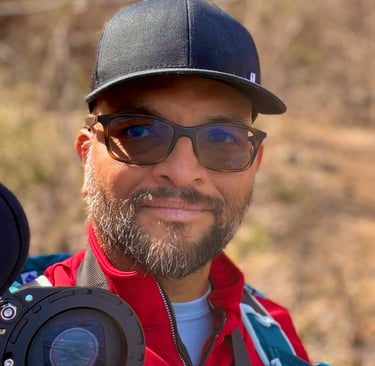
ABOUT ALEXANDER VELÁZQUEZ
ENGINEER•SCUBA DIVER • PHOTOGRAPHER
AUTHOR • MUSICIAN • EXPLORER
A personal exploration of oceans, landscapes, ideas, and the connection between them.
YOUTUBE
FLICKR