

The Silence of the Appalachians
I will never forget Saturday, August 24, 2019, in Shenandoah National Park. There were five of us on the trail that morning, friends who had spent years exploring the Appalachian Mountains together. We knew the familiar routines of a hiking weekend: pitching our tents, catching up over breakfast, filling our backpacks, and setting off into the woods. Nothing about the way that day began suggested it would stay with me so differently from all the others.
TRAILS
I will never forget Saturday, August 24, 2019, in Shenandoah National Park. There were five of us on the trail that morning, friends who had spent years exploring the Appalachian Mountains together. We knew the familiar routines of a hiking weekend: pitching our tents, catching up over breakfast, filling our backpacks, and setting off into the woods. Nothing about the way that day began suggested it would stay with me so differently from all the others.
Every summer we met to hike and camp. Some trails were familiar; others offered a reason to return. I loved those weekends, although I was almost always the least fit person in the group. While my friends climbed and carried on conversations, I was usually trying to catch my breath and wondering how far we had to go before the next break. They had waited for me more than once. On one hike, my legs cramped so badly that they had to help me finish. They never held it against me, but I remembered it whenever we planned another outing.
That Wednesday, Eric told me about a trail we had never tried. Eric led and organized the hikes of the group. We would descend about a thousand feet to a creek and then climb those same thousand feet to get back. “Bring a hammock,” he said. “We can rest down there for a while before heading up.” I agreed, then tried to prepare myself with a little exercise the day before. It was an optimistic gesture, considering how little time I had. At that point, I probably had a better chance of improving the contents of my backpack than my physical condition.
I arrived at the campsite on Friday night, pitched my tent, and joined my friends. It had been a while since I had seen some of them, and we had plenty to talk about. The following morning, we were up around six, eating breakfast and trading stories as we finished getting ready. Five of us decided to do the hike. We piled into a single car and drove to the trail.
The path descended into the forest between two mountains. There were no sweeping views of the valley, no distant ridgelines to follow with your eyes. Trees and slopes enclosed us as we made our way down. The thousand-foot descent went well enough, and at the bottom we found a small creek where we could stop and rest. One of my friends took off his shoes and put his feet in the water. I kept mine dry. Summer or not, that water was too cold for me.
We ate and rested for ten or fifteen minutes, but I kept thinking about the climb ahead. I didn’t want another bout of cramps or another afternoon of everyone waiting for me. Leaving before the others seemed like a sensible solution. “I’m going to get a head start,” I told them. “I can take it easy, and you can catch up.” Someone asked why I was leaving already, and I explained that I wanted to go slowly. They laughed, as friends do when they know your habits. “Go ahead,” one of them said. “We’ll catch up in a bit.”
I gathered my things, ate half the hamburger I had brought, and started uphill. For a little while, I followed my own advice. I walked at a comfortable pace and watched where I placed my feet. Then I began to think that, if I moved faster while I still had the strength, I could put more distance behind me and rest farther up. Before long, I was climbing much harder than I had intended. My heart pounded, my legs grew heavy, and I finally stopped to catch my breath.
I remembered a group of enormous rock formations from the descent. I had chosen them as a rough halfway point, something recognizable to look forward to on the return. When I reached them, I felt relieved. I was making progress. Behind me, my friends’ voices carried through the trees, sometimes sounding close enough that I expected them to appear at any moment. I passed the rocks and continued uphill.
A little farther along, I realized I could no longer hear them. At first, I thought nothing of it. Perhaps the rocks were blocking the sound, or perhaps they had stopped for a break. I slowed to a more comfortable pace and kept walking. Only gradually did I notice that their voices were not the only sounds missing. I couldn’t hear the wind. I couldn’t hear the animals. Even the leaves seemed still.
I stopped and listened. The silence was so complete that the forest felt unfamiliar, although I had no reason to think I had left the trail. I looked back and saw no one. For a few moments, I stood there waiting to hear something that would make the place feel ordinary again. Then I tried to dismiss the feeling and continued.
That was when I felt the first thud beneath the ground.
I froze. My first thought was that a large animal was nearby, perhaps a bear. I searched among the trees for movement and tried to pick up a scent, the strong animal smell I remembered from zoos and imagined might warn me that something was close. I saw nothing and smelled nothing. After a few seconds, I told myself it must have been my imagination.
I took a few more steps, and two more thuds came directly beneath me. These were stronger. I felt the jolts through the soles of my feet, as though the ground had lifted me. I looked in every direction, searching for a shifting branch, a moving leaf, anything that might explain what I had just felt. Nothing moved. I still couldn’t hear my friends, the wind, or the animals.
The fear came before I could make sense of it. I felt that I had to leave immediately, that something would happen to me if I stayed. I had no idea what I was afraid of. There was nothing in front of me to run from, yet I felt that I could disappear there and no one would ever find me. I started running uphill.
Minutes earlier, I had barely been able to walk that slope. Now I ran with my backpack striking my back and my breath growing shorter. Whenever I thought about stopping, the same certainty drove me on: I had to get away. I kept climbing, pushing myself long after I felt I had nothing left. In my memory, that desperate run lasted almost half an hour.
Eventually, my legs gave out. I fell to the ground, unable to go any farther, and heard a voice behind me ask, “Are you okay?” My friends were there, only a few steps away. I stared at them, struggling to breathe and trying to understand how they had caught up so quickly. I managed to say yes, but when they asked what had happened, I could hardly put the experience into words.
“Didn’t you feel it?” I asked. They wanted to know what I meant. I told them about the thuds beneath the ground, the silence, and the jolts under my feet. They looked at one another and said they hadn’t felt anything. My explanation came out in pieces. “I took off running,” I told them. “I’ve been running for about half an hour.”
One of them frowned. “Half an hour?” When I said yes, he told me they had been right behind me. I asked what he meant. “The whole time,” he said. “You were walking, and then suddenly you fell.”
I waited for someone to laugh or admit they were joking. No one did. I asked whether they had seen me running, and they said no. They had seen me walking. As far as they could tell, I had tripped.
I didn’t know how to answer. My body was spent, and I remembered running until I could no longer stand. I remembered the fear and the effort of forcing myself uphill. They remembered a walk and a fall. I asked once more whether they had heard anything unusual, but their answer remained the same. Nothing strange had happened to them on that trail.
By the time we reached the car, I had fallen quiet. They asked whether I was okay, and I told them I was fine. I had no better explanation to offer. We started driving back to camp, and somewhere along the way I began to vomit. I didn’t know what was happening to me. “Don’t stop,” I told them, leaning out the window. I vomited several times during the drive, then sat in silence again.
We reached the campsite around noon. I said I was exhausted and wanted to lie down for a while. I fell asleep, and when my friends prepared for a second hike around two that afternoon, I stayed behind to rest.
It was about eight when the smell of campfire smoke and the murmur of conversation woke me. I got up and walked over to the others. They all looked at me, as though waiting for an explanation. After everything that had happened, all I could think to say was, “I’m hungry.”
In less than a minute, a plate of potatoes, chicken, and vegetables appeared in front of me. It seemed to have fallen straight from heaven. No one asked me anything else. I sat down to eat, the conversations resumed, and soon we were sharing stories and laughing again. We ended the evening ready for another day and another adventure in the mountains.
I have never been able to reconcile my memory of that morning with what my friends described. I don’t know what caused the thuds beneath my feet or why I stopped hearing the forest. I don’t know whether fear distorted my sense of time or whether something happened that I still cannot understand. I have even wondered whether I somehow walked through a portal, though I have no way to support that idea. The questions remain.
What I remember is being alone, terrified, and running for my life on a mountain in the Appalachians. My friends remember me walking a few steps ahead of them, perhaps it was just exhaustion. And somewhere between what they saw and what I lived through, I am still missing half an hour.


_________________________
(c) 2025 deorilla.com
The views expressed here are my own and are provided for educational purposes only. They do not represent the views of any employer, agency, organization, or training agency.
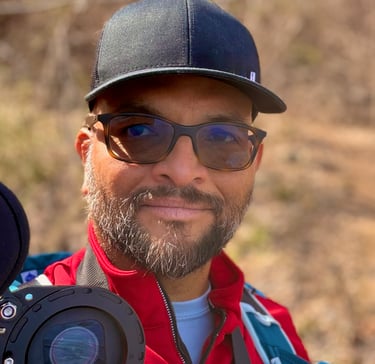
ABOUT ALEXANDER VELÁZQUEZ
ENGINEER•SCUBA DIVER • PHOTOGRAPHER
AUTHOR • MUSICIAN • EXPLORER
A personal exploration of oceans, landscapes, ideas, and the connection between them.
YOUTUBE
FLICKR